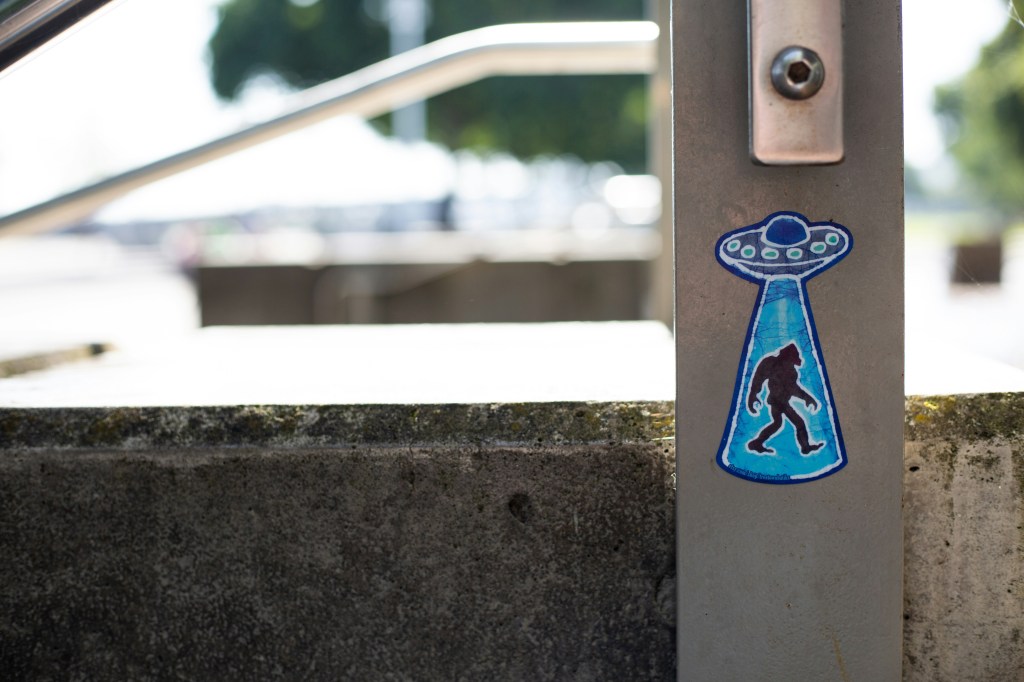
Featured Photo by Darren Halstead on Unsplash
Paranormal stories have always fascinated me. Everyone gets really invested when a game show contestant is someone from their hometown or when a favorite tv show has an episode set in their state. In many ways, paranormal stories are ways to recreate that feeling, except instead of starring hopeful contestants and small screen actors the stars are ghosts, aliens, and bigfoot. As much as I would love to engage with these stories as works of creative fiction and marvel at mankind’s skillful storytelling, I can’t. I’ve always loved seeing how elements of society connect to each other and my social work education has honed that ability to recognize unspoken systems at work.
So it really was no surprise when viewing a movie on the Bridgewater Triangle lore switched from a night of entertainment to a rabbit hole of sociological phenomena. An easy conclusion to jump to is that paranormal stories serve the same purpose in our society as mythology did in ancient ones, that is, to explain the unknown. Ancient Greece didn’t have the same technology for understanding the weather so they claimed Zeus made the thunderstorms. Similarly, contemporary humans don’t have the familiarity with the environment needed to identify what they experience in the woods, so they claim Bigfoot.
It’s an intriguing argument, but an incomplete one. If that were the case we’d expect stories to pop up about the ghosts that wreak havoc on the computer systems of retail stores or the aliens causing the persistent traffic in major cities. Instead, we often find paranormal stories are disproportionately set in rural or suburban residential areas, never in commercial settings. The stories are always people-focused, the target in the stories is a lone hiker or dog owner, maybe a couple on a drive, but never large groups or crowds.
These trends exist in paranormal stories because of the purpose these stories serve. They are not explanations they are lessons. Specifically, paranormal stories act as norms enforcement for the society that tells them. Norms are the behaviors that are accepted within specific groups. Norms can be very formal such as laws against stealing or they can be informal, such as nodding a hello to the employee who greets you as you enter. Norms are enforced in society in a myriad of ways, but for informal norms the most common ways include social judgment and risk of ostracization.
As a social species we learn from each other, so we don’t need to be exposed to these consequences firsthand to learn what the norms and boundaries of the group are. Paranormal stories act as these learning moments so members of a group can test and inform each other of the norms. Let’s first take a look at the classic Bigfoot tale. Bigfoot is usually described as primarily human-like set apart from the witness in the story by his disheveled appearance and foul odor. There’s a surface level norms enforcement happening the the labeling of what hygiene/personal grooming levels are accepted. But there’s more, particularly when you examine Bigfoot’s consistent association with wilderness.
Often claims of Bigfoot sightings are written off as a bear the witness didn’t get a clear enough view of to identify properly. But if that were the only reason behind Bigfoot sightings why don’t we get sightings of him in your suburban neighborhood rifling through your garbage for food scraps? Because Bigfoot sightings and the stories we tell about people who see or believe in Bigfoot also serve to delineate boundaries of where people do and don’t belong. People belong as part of the mainstream, not on the fringes of society.
I primarily engage with the surface-level paranormal stories meaning I tend to find compilations of stories and urban legends. And I’ve noticed some trends in the kinds of stories they group together. Unsurprisingly cryptids are often paired with aliens/UFOs and ghosts. It almost makes sense that they’d be lumped together. They all involve beings that some claim to have seen or had experiences with that the vast majority of the population ‘can’t’ see. They’re all well known enough that a passing interest isn’t going to be ridiculed though hardcore believers are often socially ostracized for their beliefs. And in two different ways, we are starting to see the us versus them mentality that these beliefs and the stories we tell about them create.
Sometimes as a reason for the paranormal experiences, these compilations will often include stories about Indigenous peoples. The way these pieces of media depict Indigenous groups and the impact that they, their religion, or their oppression had on the land is a very othering phenomenon. Often the tone taken is that the use of the Indigenous culture adds validity to the stories in a way that is very reminiscent of harmful stereotypes of the “mystical savage”. There are overt racial tones of these stories through the way they always center the negative impacts these paranormal experiences leave on the always white storyteller. But there is also the ongoing cultural genocide that says people who practice non-Christian religions and non-Eurocentric lifestyles are other and are to be feared.
Last but not least, these compilations will usually include some story about satanic rituals. Yes, many of the stories featured will stem from the 80s Satanic Panic that swept through America, but we can still learn a lot about our society from which ones stick around to be connected to these paranormal stories. Almost always the stories of satanism mentioned in these paranormal compilations will take place either in the woods or in low-income neighborhoods. Almost always these ‘satanic rituals’ will be tied very directly through crime whether the group is perpetrating some violence or engaging in the use of illicit drugs. In this portion of the compilation, law enforcement will usually be featured in the interviews.
Inevitably, they’ll say that there was no evidence of any actual satanic rituals, but that teens were influenced by these stories to spray paint some pentagrams. The obvious layer of norms enforcement is that crime is bad, but beyond that, these stories reinforce the idea that rebellion is not accepted. Satanic ritual stories in particular drive home the point that societal cohesion is dependent on adherence to the current systems of power.
And this is really where these assessments of norms enforcement lead us: what systems of power are we upholding with our participation in these stories and are we ok with upholding them? Rather than berating ourselves for how we’ve engaged with these stories in the past, I encourage us to use this as an opportunity to reflect on the changes we can make in our current behavior to build a better future.


 Making the Internet My Accountability Partner
Leave a comment